
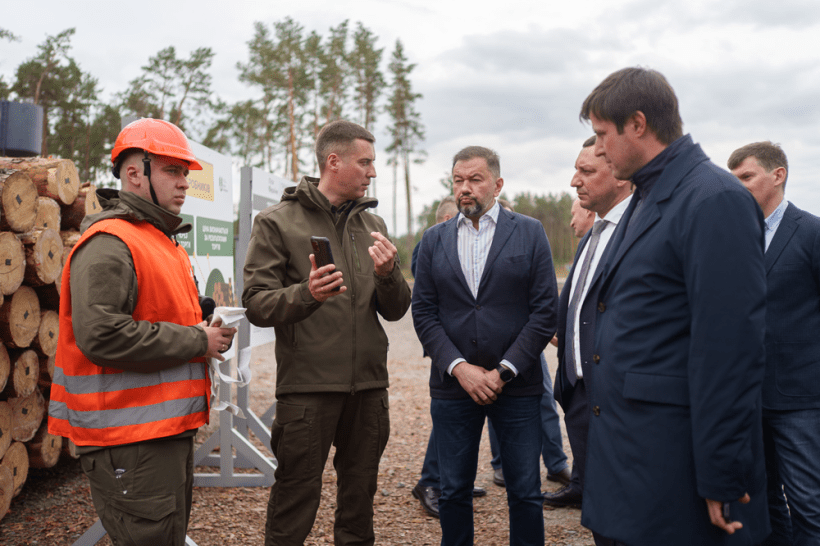
The active development and improvement of forest seed production is particularly important for post-war forest restoration and for boosting the sector’s economic potential. That is why a field meeting was held to discuss improvements to legislation governing forest reproductive resources. This was announced by Viktor Smal, Head of the State Forest Resources Agency.
“Together with Taras Vysotskyi, Deputy Minister of Economy, Environment and Agriculture, members of parliament Oleg Bondarenko and Oleksandr Matusevych, as well as Ihor Zubovych, Chair of the Commission on the Transformation of the State Enterprise ‘Forests of Ukraine’, we examined in detail the preparation of draft law No. 9116 ‘On Forest Reproductive Resources’ for its second reading, and also discussed the necessary amendments to the Forest and Land Codes to ensure sustainable forest management,” said Viktor Smal.
He added that the field meeting had been specially organised at the Chernihiv Forest Breeding and Seed Centre – Ukraine’s largest centre for growing seedlings with a closed root system. Here, all those present had the opportunity to observe the full cycle of work: from the collection, preparation and storage of seeds to the cultivation of seedlings with closed root systems in greenhouses and on nursery fields.
These findings formed the basis for discussions on the necessary legislative initiatives. In particular, these include:
– improving the legislative framework for forest seed production;
– establishing clear rules for quality control of reproductive resources;
– ensuring compliance with EU requirements;
– preserving the genetic potential of Ukrainian forests.
According to the head of the State Forest Resources Agency, there is currently a shared vision of how to take the forest seed production sector to a qualitatively new level – so that it meets EU standards and requirements, meets Ukraine’s needs for forest regeneration, and has clear rules for the production and use of seeds and seedlings.
“Work on amendments to draft law No. 9116 is ongoing. I am confident that through our joint efforts we will be able to produce a high-quality document that will shape the further active development of forest reproductive resources for many years to come,” concluded Viktor Smal.