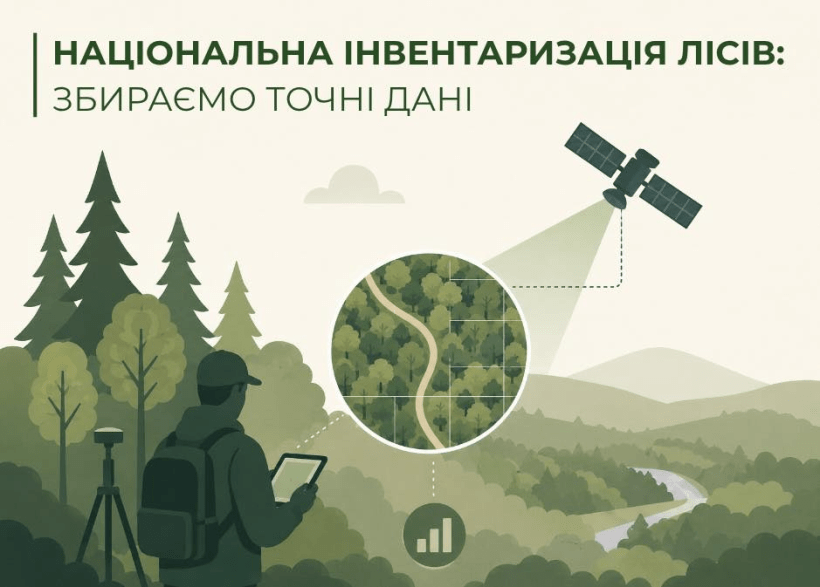
Accurate data is essential for effective forest management, which is why the National Forest Inventory (NFI) is currently underway in Ukraine. It is a key tool for understanding the true state of our forest resources, as well as the foundation for modern forest policy and decision-making regarding the protection, restoration and use of forests. And even under martial law, this work continues. This was announced by Viktor Smal, Head of the State Forest Resources Agency.
“The National Forest Inventory (NFI) is not merely a tree count, but a systematic, scientifically based process that provides a comprehensive picture of the condition, dynamics and resource potential of forests. It involves regular sample surveys that provide reliable data for sector management, strategic planning and environmental monitoring. This work is also of great importance for Ukraine’s European integration,” explained the head of the State Forest Resources Agency.
He noted that the forestry sector is preparing to meet the requirements of the EU Regulation on Combating Deforestation (EUDR), which mandates transparency regarding the origin of timber and the traceability of forest resources. This requires accurate digital maps, modern databases and satellite monitoring.
The National Forest Inventory Centre of the Ukrderzhlisproekt Association is responsible for carrying out the National Forest Inventory. Between 2021 and 2025, over 7.000 inventory plots were surveyed, ensuring the representativeness of the data and the continuity of observations.
“Thanks to this, we have reliable and statistically sound data on the quantitative and qualitative characteristics of forests, their resource potential and the changes that occur over time,” said Viktor Smal.
According to him, the full-scale Russian invasion significantly affected the pace and scale of the National Forest Inventory and complicated the work: due to funding cuts, field teams often worked with the bare minimum of resources, whilst the security situation restricted access to parts of the territory. Despite this, the National Forest Inventory did not stop.
“In response to the challenges of the war, a forest inventory based on remote sensing (RS-Inventory) was introduced in 2023. It has become a temporary alternative to traditional fieldwork and is being implemented with the support of international partners,” explained the head of the State Forest Resources Agency.
He added that international aid during the country’s most difficult times played a crucial role in continuing the National Forest Inventory: thanks to the support of the German Federal Ministry of Agriculture, Food and Regional Identity (BMLEH), provided through the implementation of the SFI-Project, it was possible to significantly expand the geographical scope of the work.
Also, as part of international support, specialists received modern monitoring equipment, computer hardware, off-road vehicles for field teams, and new technologies for data collection and processing.
Work is currently continuing in safe regions, with the main focus on digitalisation. Among the priorities for the development of the NFI are:
– integration of ground-based data with satellite monitoring;
– creation of digital forest maps;
– development of a centralised GIS infrastructure;
– preparation for the implementation of European standards on forest data transparency.
“Despite the war, we continue to systematically collect critically important data on forests. This is our strategic investment in environmental security, sustainable resource management and the country’s international commitments. An investment in our future,” concluded Viktor Smal.