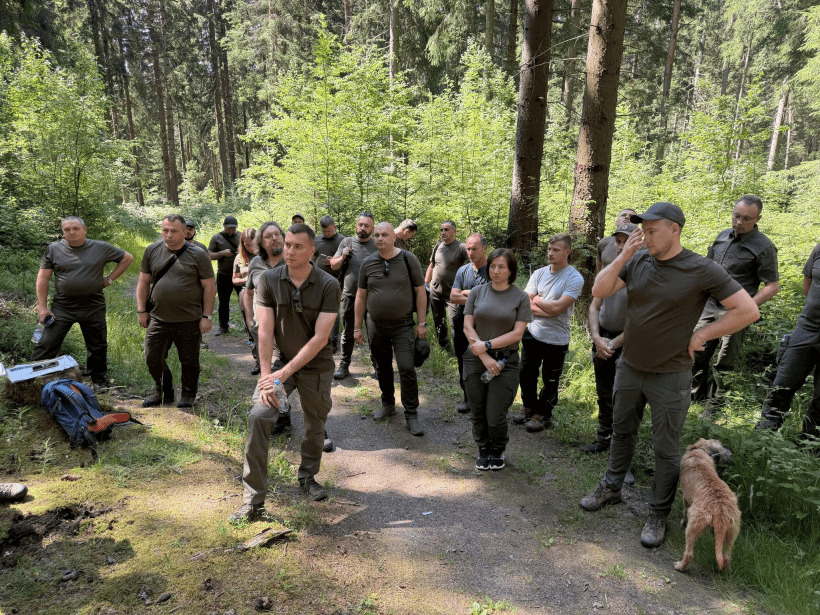
A week of training in Germany as part of a practical course on close-to-nature forestry for Ukrainian foresters has come to an end.
“Such visits are, first and foremost, a professional exchange of experience. Ukrainian foresters have extensive professional experience and their own approach to forest management. We are carefully studying the practices of our European colleagues, analysing them and determining which solutions can be effectively adapted to the Ukrainian context. At the same time, I am convinced that Ukrainian experience is also of interest to our international partners today,” remarked Viktor Smal, Head of the State Forest Resources Agency.
During a study visit to the Modrak private forestry enterprise in Bad Lausick, Ukrainian specialists learnt about approaches to growing high-value timber in deciduous stands, and at the Leipzig Forestry Enterprise – about methods of natural regeneration of oak stands.
The group also visited the Grünheide Forest District, where their German colleagues demonstrated practical approaches to stand restructuring: marking trees for felling, planting silver fir, and establishing undergrowth crops.
Special attention was paid to issues relating to the organisation of wildlife management, wetland restoration, water retention in the forest, the protection of drinking water and the management of recreational areas.
“Every country has its own natural conditions, legislation and traditions of forest management. That is why our task is not to copy other countries’ solutions, but to assess them critically, adopt best practices and adapt them where they can genuinely benefit Ukrainian forests,” emphasised the head of the State Forest Resources Agency.
He thanked his German colleagues for their openness to professional dialogue and their willingness to share their experience, as well as the Bundesministerium für Federal Ministry of Agriculture, Food and Regional Identity (BMLEH), which supported the implementation of this project, and the Association for Close-to-Nature-Forestry in Germany (ANW), which acted as its implementing organisation.