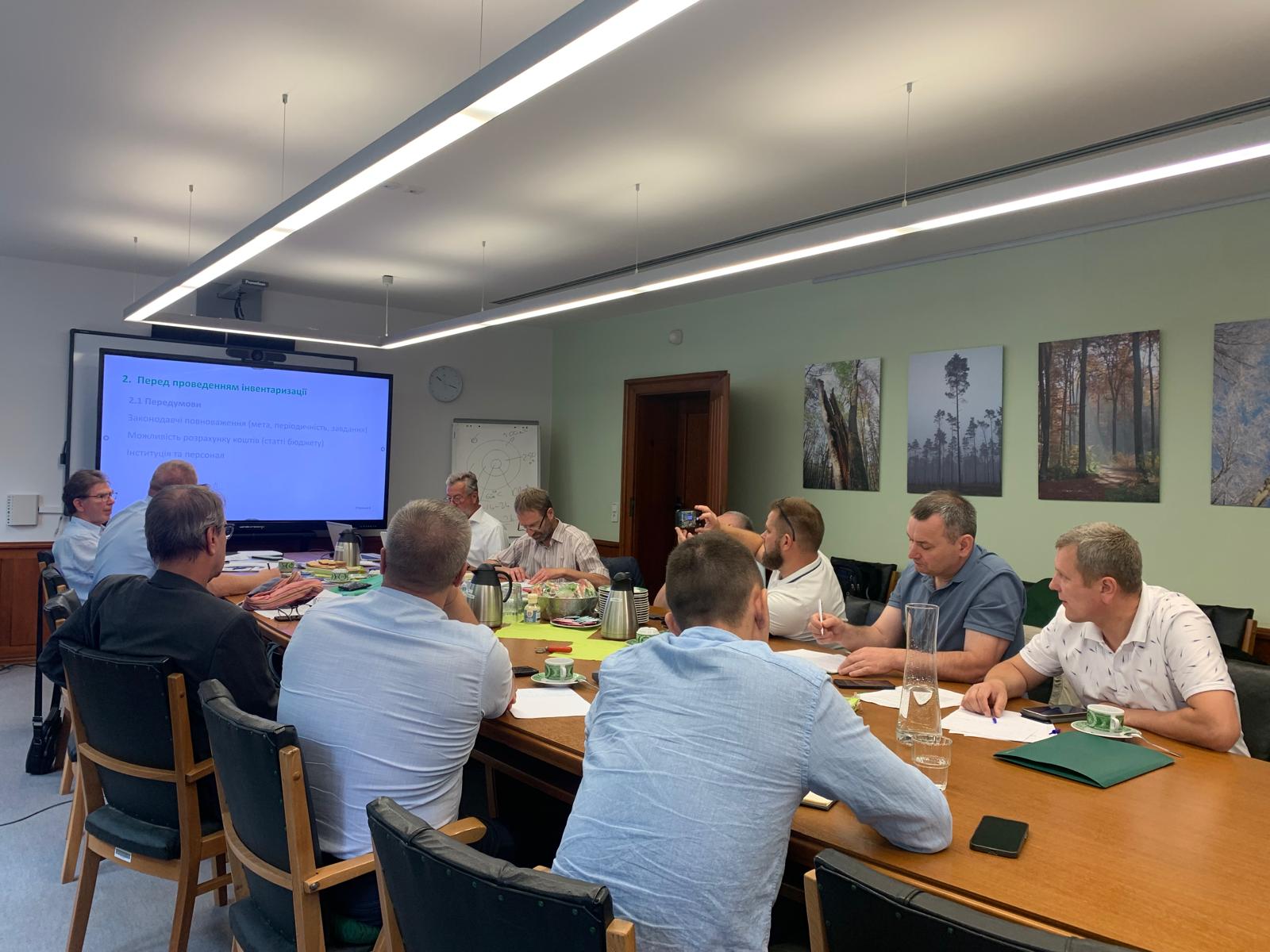
From 06.07 -09.07.2026 six Ukrainian forestry experts under the leadership of Ihor Budzinskyi, Head of department of forestry and forest restoration of State Forest Resources Agency of Ukraine travelled to Germany with the objective to share Ukrainian achievements with regard to NFI, gain capacities based on German experiences in Bundeswaldinventur (BWI) and discuss options for further development of NFI in Ukraine.
The Specialised Information Trip (SIT) was organised by IAK Agrar Consulting Leipzig and the SFI- Project, namely with assistance of the SFI expert Heino Polley, former Head of technical implementation of BWI at Thünen Institute. The SIT had the objective to Improve capacities with regard to NFI in Ukraine, namely with regard to
- Public relations related to NFI; settings the scope of criteria’s – conclusion for deregulations of NFI in Ukraine
- Forest policy approaches related to BWI: legislation, organisation of responsibilities and implementation, financing
- Update on methodology of BWI
- Remote sensing based approaches in NFI
- Soft- and Hardware for field data gathering and processing
- Application of BWI/NFI outputs as a base for policy decision making
- Publication of BWI/NFI outputs, including field data
In preparation of the SIT Ukrainian delegation put forward a wide bunch of concrete questions ranging from “What is the legal and regulatory framework governing the NFI in Germany?” to “What share of expenditures is allocated to fieldwork, data processing and reporting?” which then have been discussed with the German experts. Meetings took place in the premises of the Forestry Competence Centre of the Brandenburg Forst Enterprise in Eberswalde (LFE).
The first day Volker Sasse, SFI-Project Leader, welcomed the delegation and expressed his hope that the current visit will contribute with concrete recommendations and new knowledge to the further successful implementation of NFI in Ukraine.
After an introduction of participants around the table Heino Polley greeted the delegation and introduced participants to the program of the SIT. During the morning session Polley presented to the Ukrainian experts the general approach of BWI, particularly with regard to public relations and collaboration between scientists and policy makers. Later on he focussed the exchange on the methodology of BWI, where data gathering in the forest is less time consuming compared to NFI of Ukraine. Ideas for the optimisation of the NFI in the Ukraine were discussed.
The afternoon session was dedicated to a presentation on the National Forest Inventory in Ukraine. Maksym Fesiuk, Senior engineer of the Centre of National Forest Inventory of Ukraine (CNFI) informed representatives of LFE, Thünen-Institute and Eberswalde University of Sustainable Development about the policy and administrational framework, methodology, current developments and results of the first cycle of NFI. In his presentation “National Forest Inventory of Ukraine – NFI-1 Experience and Transition to the Second Cycle (NFI-2)” he explained how the Russian war in Ukraine hampers the implementation of traditional field data based NFI significantly, mainly due to limited access to all Ukrainian forest areas and shortages state financing of NFI. This situation forced to use alternative approaches, namely a remote sensing based methodology. Another bottleneck for traditional NFI is the data gathering and processing software, where Ukraine seeks support.
The first day was closed by another round of “Questions and Answers”.
The second day of the SIT Thorsten Wiebke, responsible at LFE for BWI, special Inventories for State Brandeburg and Carbon Inventories, presented the BWI implementation in State Brandenburg, namely data collection, financing, organisation, software and reporting, Wiebke presented further a new software for Inventory administration and demonstrated the connections between Forest Inventory and Forest Management Planning in Brandenburg.
Dr. Rainer Hentschel, Head of the Forestry Environmental Monitoring Section of LFE, presented the approach towards Forest Environmental Monitoring. He concluded that environmental changes require an increasing data availability and challenge the work of inventory groups, data manager and administrative staff. “Monitoring standards are necessary to ensure that the results are comparable and can be interpreted meaningfully. Open-source solutions help facilitate the sharing of IT developments, harmonize surveys, and improve data quality.”, said Hentschel.
In the afternoon a field excursion was organised by LFE, where Ukrainian experts got practical insights of data gathering during BWI, details on quality assurance in the field via Control Teams. Later in the afternoon Wiebke presented the newly developed software for BWI field teams which is available as open-source software. Options for implementation of this software in Ukraine have been discussed.
On the third day of the SIT representatives of BMLEH and GFA joint the meetings and discussions.
Katalin Solymosi, Policy Officer at the Department for European and International Forest Policy of BMLEH thanked for the opportunity to join the presentations and to be a part of the discussions. “It is important to get in touch with the experts, who implement the project which we are supporting financially”, said Solymosi.
Manfred Fischer, Programme Director, Bilateral Cooperation Programme BMLEH – Forestry of GFA welcomed the Ukrainian experts. He expressed his hope that the SIT will contribute to the successful implementation of NFI in Ukraine. “Obviously realisation of NFI in Ukraine is hampered by the war. Also new methodological challenges are appearing, where the SFI-Project can support with advice”, said Fischer.
Afterwards Friedrich Schmitz, responsible for BWI at the Federal Ministry of Agriculture, Food and Regional Identity (BMLEH), presented “Experiences from political coordination and management of the National Forest Inventory in Germany”. Based on his long-term records he was able to provide conclusions with regard to the strategic approach. Schmitz answered a broad variety of questions by Ukrainian participants with regard to the legal base, organisation, financing, public relations and reporting, etc.
The SIT was closed with a dinner of all German and Ukrainian participants. Ihor Budzinskyi, Head of the Ukrainian delegation thanked on behalf of the whole delegation for the opportunity to learn from German BWI records.
The following conclusion could be drawn for the further development of NFI in Ukraine:
- NFI is an essential tool for forest policy decision making on both forest resource development and forestry potentials.
- Public relation activities are of outstanding importance for the acceptance of NFI needs by the forestry network and general society.
- According to NFI Regulation (2023) provisions for the period of martial law the first cycle of Ukrainian NFI may be formally prolonged, – but despite temporary inaccessibility of some forest territories and significant shortcomings in terms of completion of field data gathering in the originally planned manner – there is a need to present results of first 5 years of NFI implementation.
- Alternatives have been developed and implemented, namely an RS-Inventory, to overcome these shortcomings.
- A dashboard and public report on NFI results from formal 1st NFI Cycle should be published by beginning of 2027, together with conclusions and a brief outlook on the 2nd NFI cycle.
- The formal 2nd NFI cycle starts in 2026: with a focus on repeated field data analyses, extension of field data plots to be implemented, as the budget allows.
- The newly develop software package for BWI in Germany represents a powerful tool with potentials to be applied in Ukraine. It requires translation and comprehensive adaptation to Ukrainian NFI standards, although these standards should be a subject of deregulation, taking German experiences into account. Adaptation requires significant resources for programming – beyond current SFI budget possibilities.
- German experiences on outsourcing field data gathering will be explored more closely by SFMPA.
Also, the German experiences in distributing financing and data gathering implementation to regional entities (German federal states) with federal responsibility to organise and control the process as well as to analyse BWI field data seems a subject to be explored as an potential option for Ukraine.