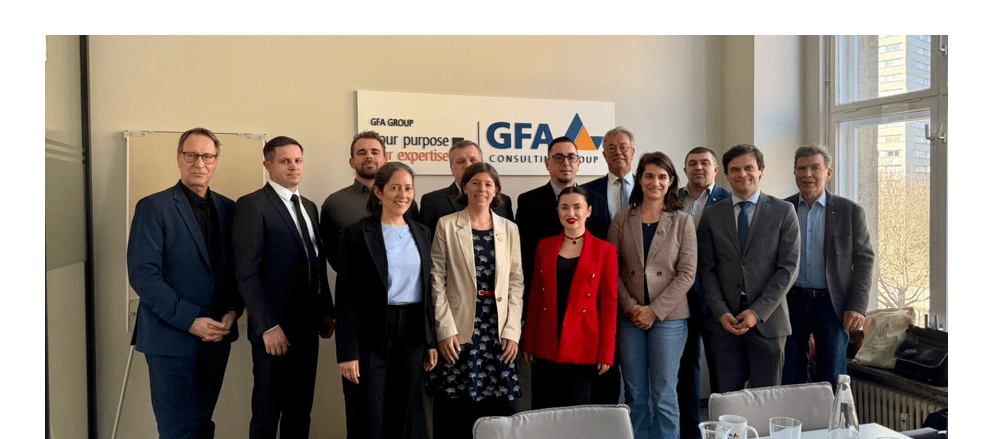
At the end of March, the SFI Project organized a three-day Specialized Information Trip (SIT) to Berlin, Potsdam, and Dresden to study German experience in sustainable forestry management. Six experts representing various Ukrainian institutions—including the State Forest Resources Agency, the Ministry of Economy, Environment and Agriculture, and the Verkhovna Rada—took part in the trip.
The SIT began on 17.03.2026 in Potsdam, where participants were introduced to the main tasks and organizational structure of the State Forest Service Brandenburg. This entity is responsible for (i) implementing forest policy regulations across forests of all ownership types and, at the same time, (ii) managing state-owned forests, and is structured accordingly.
Sabine Kühling, as representative of the German Forest Society (DFV), gave a short introduction to the programme of the next days and afterwards Volker Sasse welcomed the participants on behalf of IAK Agrar Consulting GmbH and the SFI Project.
Bert Harder, Head of ForestGIS, informed SIT participants about the approach to Forest Management Planning (FMP) in Brandenburg, including inventory, planning, and controlling, based on a stand-wise, GIS-supported database. The planned sustainable forestry measures, particularly the roundwood removals, are coordinated and agreed with other administrative bodies and subsequently published in the official gazette of the Brandenburg state government.
“The control of forestry activities includes the systematic analysis of the implementation of medium- and long-term plans (‘target–actual comparison’, ‘plan-success control’), as well as fundamental investigations and assessments of the level of sustainability in forestry and forest development,” said Harder.
Subsequently, Bernd Rose, Officer for Forest Management Planning, presented the key elements of the coordination between the State Land Cadastre and the Forest Management Planning GIS, including cadastral data and statistics on forest land use and ownership.
After returning to Berlin Manfred Fischer, Programme Director, and Cristabel Durán Rangel, Project Manager (both from GFA Consulting Group GmbH, as General Agent of the Federal Ministry of Agriculture, Food and Regional Identity (BMLEH) for the Bilateral Cooperation Programme Forestry (BKP-Forestry)), welcomed the Ukrainian delegation. The meeting focused on improving direct communication between project partners, particularly given the difficulties of holding in-person meetings in Ukraine, the need to clarify roles, responsibilities and organisational structures (e.g. Project Steering Group (PSG) composition). Key discussion areas included the Project work plan as well as priority topics such as forest demining and environmental impact assessment. The need for ongoing cooperation and regular quarterly meetings at the PMU level was also emphasised. The financial constraints for 2026 were also highlighted, with limited prospects for increased funding.
Although the current report addresses the outcomes of the SIT in terms of capacity building, the main purpose of the trip to Germany was participation in the bilateral Project Steering Group meeting of the SFI project, held the following morning (18.03.2026). The meeting aimed to present the project’s achievements, facilitated professional exchange on priority issues related to sustainable forestry in Ukraine, and agreed on the SFI work plan for 2026.
After the PSG meeting, the participants visited the Deutscher Holzwirtschaftsrat (DHWR – German Timber Council), the top-level representative body of the German timber sector, which brings together various associations from the forestry and wood industries. During his presentation, Lukas Freise, Managing Director of the Working Group Raw Timber, provided the Ukrainian experts with a detailed overview of his organisation’s approach to implementing the EUDR regulation and outlined the expectations of German wood product importers. The challenges faced by Ukrainian wood exporters were discussed intensively and put in the context of a more general evaluation of EUDR effectiveness.
The next day, 19.03.2026, the group of Ukrainian forestry experts travelled to Dresden. Dirk-Roger Eisenhauer, Head of the Competence Centre for Forests and Forestry, together with his colleagues, prepared a comprehensive introduction to the tasks and organisational structure of the Saxony State Forestry Service, focusing on selected issues of particular interest to the Ukrainian experts.
A series of presentations was opened by Utz Hempfling, Managing Director, who presented the status of forest resources in Saxony as well as the tasks and organisational structure of the Saxony State Forestry Service. During the discussion, the following key points were highlighted:
- Final clear-cuttings play only a very minor role in Saxony, as both economic and environmental considerations favour thinning as the preferred method of timber harvesting.
- Areas of natural forest succession, regardless of ownership, are legally defined as forests.
- Forest owners are responsible for complying fully with forestry legislation.
- Additional costs incurred by the Saxony State Forestry Service for ecologically sound measures are financed from the state budget, not from the income of the state forestry management.
Further presentations were focussed on:
- Forest Management Planning
- Implementation of the EUDR in the Saxony State Forestry Service
- Legislative and administrative regulations on forest reproductive material
- Analysis and mapping of growing stock, based on ALS data (Airborne Laser Scanning)
In the afternoon, the Ukrainian experts had the opportunity to participate in a brief field excursion to a tree nursery, seed orchards, and sites dedicated to genetic conservation. A comprehensive field manual titled: Conservation, breeding and provision of forest reproductive material for the management of forests in Saxony. As a summary: Ukrainian experts deepened their expertise about key forest policy approaches in Germany respectively in EU and are now enabled to use this knowledge in their daily work, directly applying it for decision making respectively sharing it with others, working in the Ukrainian forestry sector to the sake of protection of forests and sustainable development of forestry.